What is Foresight?
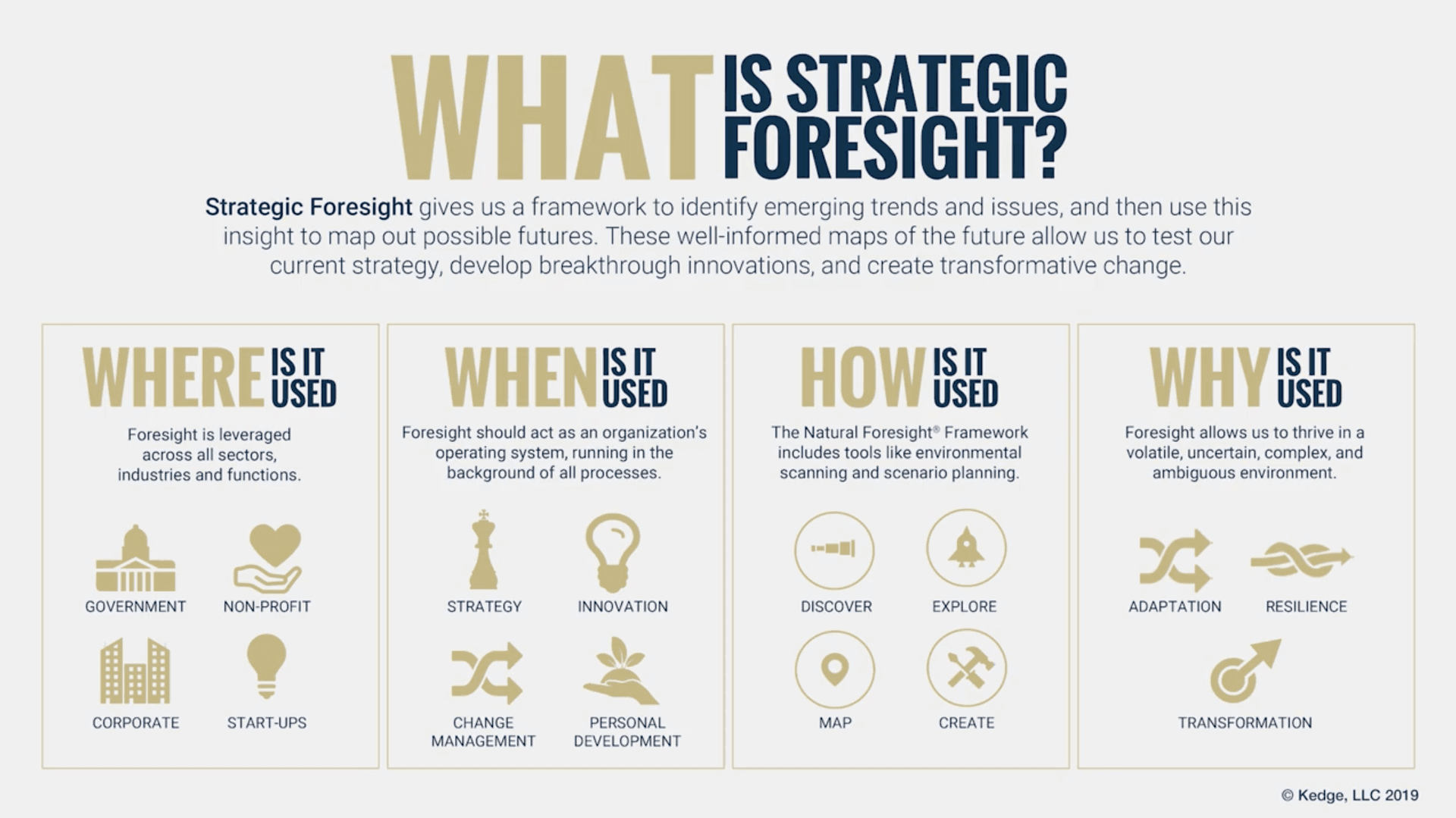
What is Foresight?
Foresight is a systematic, participatory, future-intelligence-gathering and medium-to-long-term vision-building process aimed at enabling present-day decisions and mobilizing joint actions. It can be envisaged as a triangle combining "Thinking the Future", "Debating the Future" and "Shaping the Future".
Foresight is neither prophecy nor prediction. It does not aim to predict the future — to unveil it as if it were predetermined — but to help us build it. It invites us to consider the future as something that we can create or shape, rather than as something already decided.
Foresight enhances existing policy and planning methods: by broadening our horizon; by opening up space for other stakeholders in the future; and by offering a platform to start negotiating values, perspectives and vested interests right from the beginning of our response to or initiation of change.
Why Foresight?
UNDP Global Centre for Public Service Excellence promotes the use of foresight by the government in developing countries. The four major areas where foresight can make an important contribution:
- Alignment of Development Visions — Foresight provides mechanisms, processes and methods for the kind of engagement that development visioning requires and citizens demand.
- Anticipatory Governance and Strategic Management — Foresight enables governments to anticipate emerging trends and evaluate the implications and impact of their policies under different circumstances.
- Resilient Policy Planning — Foresight is emerging as one of the approaches to infuse classical policy planning with a manageable dose of uncertainty and unpredictability.
- Policy and Public Services Innovation — Recently, foresight has been coupled with a new wave of technological, social and public innovation, creating an electrifying new field of application.